Have you ever seen a child spend twenty minutes building a tower, only to knock it down with a single swipe of their hand? Or dig the same hole in the sandpit for three days in a row?
From an adult’s perspective, these activities can seem completely pointless. After all, the tower ends up on the floor, and the hole leads nowhere.
However, all this seemingly meaningless play is actually how children make sense of the world around them.
We must remember that these little humans do not have a lot of experience being humans. Many of the things we take for granted are still brand new to them. Why shouldn’t shoes go on your hands? Why can’t you climb on top of the fridge? And if birds can fly, why can’t you?
Play allows children to test ideas, solve problems, and figure out how the world works. Every tower, sandpit excavation, and failed bird-catching mission is teaching them something. The more we learn to recognise these patterns, the easier it becomes to see that play isn’t a break from learning - play is learning.
1. Communication
Most people don’t realise just how much talking happens during play. Arguing with their food, explaining rules to a tree, or demanding that their red t-shirt turn blue — all these situations present opportunities for children to practise their communication skills.
When a child is having a tea party with their toys, where Ms Unicorn doesn’t want the pink tiara and Mr Bunny eats only bananas, they are practising their verbal skills and trying to use words they already know in the right context. When another child joins in, acting like Dr Crocodile, who was late for the party, this can create a low-pressure environment for both children to learn new words from each other.
This happens very suddenly and naturally. Children are constantly collecting information about the world around them. So, when a new child joins the group, trying to explain a game he played with his sister seven months ago, other children are often introduced to new words in a context that makes sense to them.
I once saw two siblings argue for almost ten minutes about whether Spider-Man was stronger than Baby Shark. After a long debate, they eventually agreed that their mum was the strongest because she could make chocolate cake.
2. Problem-solving skills
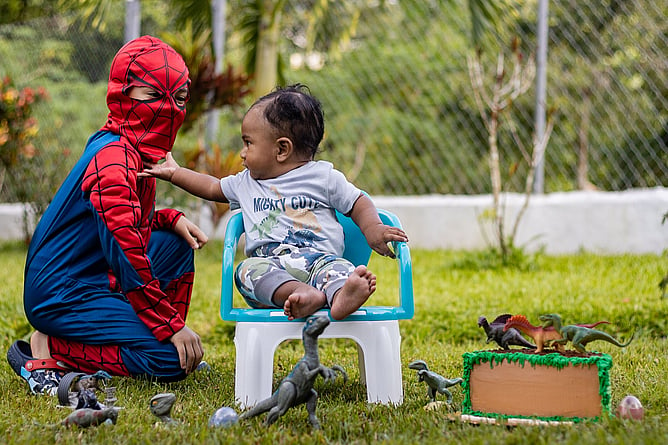
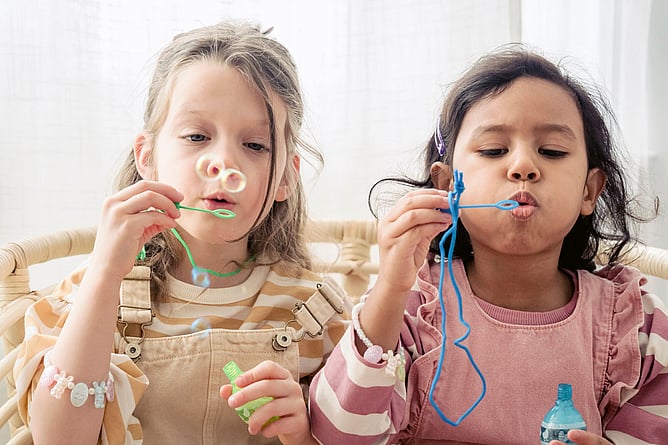
Once, I witnessed a toddler trying to catch bubbles in his mouth.
Why?
Because every time he used his hands, the bubble popped. After a few failed attempts, he decided his mouth might work better.
It sounds ridiculous, but that is exactly how problem-solving works. When children encounter a problem, they search their limited library of knowledge and try to find a way to solve it.
Whether they are playing hide and seek, doing a puzzle, putting on shoes the right way, or trying to fit an entire train set back into a box, children are constantly experimenting. Every mistake gives them new information.
The key here is to give children time to try, fail, and try again, offering support when they need it.
What we need to remember is that children’s thinking patterns are different from adults’, so their solutions can be more creative and often unexpected. To an adult, catching bubbles with your mouth sounds ridiculous. To a toddler, it is simply another experiment.
The bubble kept winning, but the toddler was learning.
3. Emotional regulation
I once watched an infant spend ten minutes trying to catch a sparrow. Every time the bird hopped away, the child would crawl after it. The bird would hop away again, but the child remained optimistic.
Until she wasn’t.
The frustration arrived very quickly after that.
Moments like these are opportunities for children to learn about emotions. Waiting for a turn on the swings, being told there is no more room in the rocket ship, or losing a race can all trigger big feelings in these tiny humans. Play provides plenty of opportunities for children to feel frustration, disappointment, and even excitement.
Not winning a game the child didn’t even know existed five minutes ago can ignite such strong emotions that you will be surprised by their intensity. With support from a calm adult, these moments can help children learn to recognise their feelings and find ways to manage them. And unfortunately for adults, practice involves getting it wrong a few times.
4. Creativity and imagination
This skill is probably my favourite. Mainly because you never really know what is going on inside a child’s head until you ask.
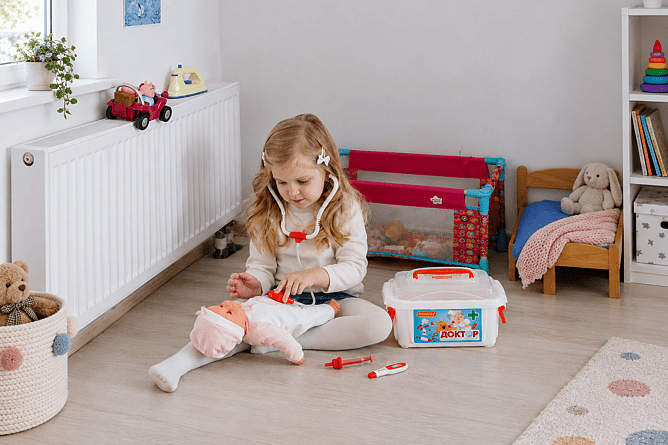
I once saw a child sitting with three baby dolls and assumed she was pretending to be a teacher. But when I asked her, she looked at me as if I had asked the most ridiculous question imaginable. Because she was actually a princess who was commanding her knights to water her garden.
Over the years, as a teacher, one thing I have learnt is that children’s pretend games are never to be underestimated. A cardboard box can become a castle, spaceship, cave, bakery, or dragon lair. The options are endless.
Once, a child told me he was making a tall tower with blocks. Further conversation revealed that he wanted it to reach the sun because he was feeling cold down here. And honestly, when that is the goal, suddenly the tower doesn’t seem nearly tall enough.
Children see the world very differently from grown-ups. Imaginative play gives them the freedom to explore ideas, test possibilities, and create solutions that make perfect sense to them, even when they leave the rest of us completely confused, or secretly impressed.
5. Independence and confidence
I once knew a young boy whose baby sister had just started in nursery. Every morning, he would insist on carrying both his bag and his sister’s bag, so their mum only had to carry the baby.
There was just one problem.
He couldn’t actually carry both heavy bags.
So instead, he dragged them behind him all the way to the classroom.
No teacher or parent ever stood in his way. In fact, most adults would quietly open doors for him and wait patiently for him to pass. The trip took considerably longer than it needed to, but nobody seemed particularly concerned about that.
And neither was he.
He was too busy being proud of himself.
These moments might seem small to us, but they are a big deal to children. Making a choice, solving a problem, or accomplishing something on their own can help their confidence grow.
It is fascinating to watch what happens once children realise they can do something by themselves. Suddenly, they want to do everything by themselves.
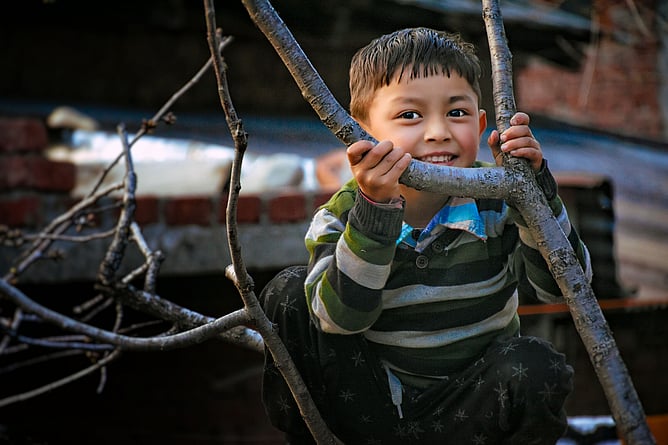
Just because a child can’t climb a tree today doesn’t stop them from trying again tomorrow. And the next day, and the day after, until they finally get to the top. From then on, they might be looking for the next tree or piece of climbing equipment to conquer - and perhaps, one day, a mountain. These everyday experiences give children opportunities to build resilience and confidence through doing things for themselves.
Play is learning
Children don’t play simply because they are bored or because it is their default setting. Play is how they learn to function in a world that is still brand new to them.
Whether they are debating if Spider-Man is stronger than Baby Shark, trying to catch bubbles with their mouths, building a tower to reach the sun, or dragging two backpacks across a nursery carpark, they are learning valuable skills that will stay with them for life.
So, the next time a child spends twenty minutes transporting toy dinosaurs across the room for reasons known only to them, remember that they may be learning far more than it appears.
About the Author
Rose is an Early Childhood Educator based in New Zealand, with a passion for child development and the incredible learning that takes place during the early years. Having worked with infants, toddlers, and preschool-aged children, she enjoys sharing practical insights inspired by everyday experiences in the classroom.
Through storytelling, real-life observations, and evidence-informed practice, Rose writes about play, behaviour, curiosity, creativity, and the many ways young children make sense of the world. Her goal is to help parents and educators better understand and support children's learning while celebrating the wonder of childhood