5 Percent for Under 5s
We’re calling on the government to commit to a 5 percent cost adjustment for ECE providers in the 2026 budget, starting from 1 July 2026.

5 Percent for Under 5s
We’re calling on the government to commit to a 5 percent cost adjustment for ECE providers in the 2026 budget. Specifically we recommend government allocate funds to achieve a 5.76% increase to all funding rates on 1 July 2026.
That’s only half the gap between what government has put into early childhood education and inflation since 2019. This is due to inflationary effects on government revenue since 2019. That’s despite early childhood education being one of the best things we can give our young people.
As a result, the future of quality early childhood education is increasingly at risk. More centres are closing. More are having to increase prices for parents, at a time when many whānau are struggling already.
Improved government investment is needed to ensure early learning services can continue to deliver safe, reliable care and strong learning outcomes for 193,033 children (2025). A 5% increase in the 2026 budget would help to close the gap, helping keep services viable.
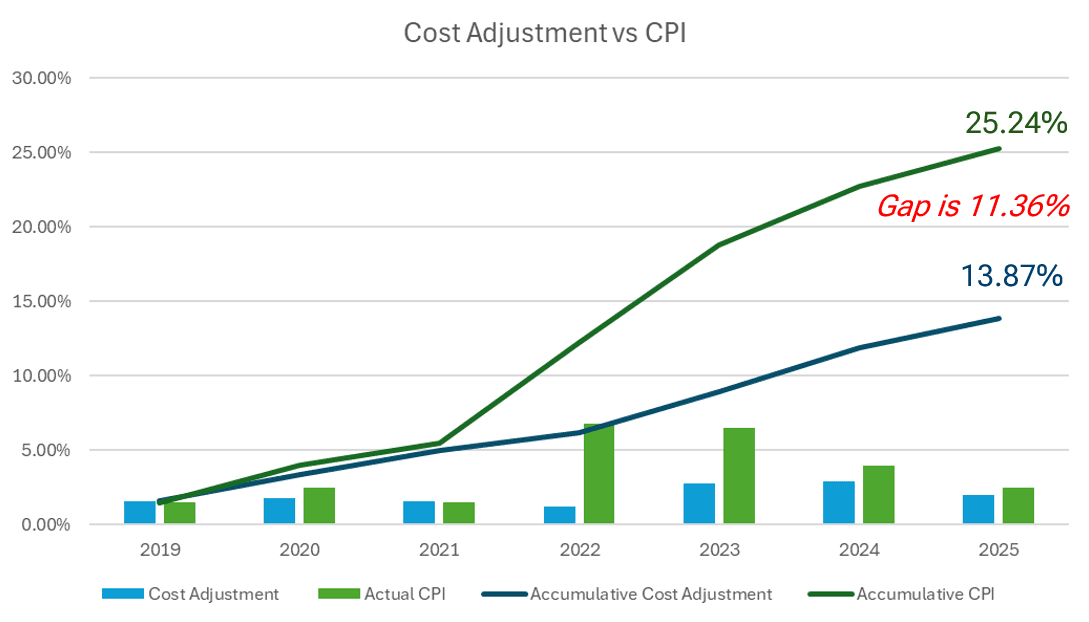
Our data shows that the cost adjustments for providers have not been keeping up with the levels of inflation over the past few years. This gap means centres are forced to cut costs and/or find income through other streams, like increasing parent fees. The chart shows how significant the gap has grown.
Other reports
We've been monitoring trends in the ECE sector which clearly show that current funding is not meeting the needs of centres. Many ECE providers in New Zealand are struggling to keep up with rising costs, creating an alarming situation for both centres and the children and families they support.
ECC's Pay Parity Closures Report shows 443 early childhood services closed between March 2022 and July 2025. Education and Care services have been hit the hardest, making up over half (224) of closures. The Pay Parity scheme, combined with ongoing COVID impacts and sustained underfunding from the Government, is severely damaging the sector. This rise in closures puts the future of accessible, high-quality early childhood education and care at serious risk.
Our ECE Debt Report shows the total amount of ECE debt to IRD (mainly GST and PAYE) has risen from $7 million (2014/15) to $27 million (2024/25), nearly 300%. Non-payment of PAYE is a worrying financial sign for ECE entities, failure to deduct PAYE is recoverable by the Crown as employers (and PAYE intermediaries) are deemed to hold the tax in trust to the Crown.
A recent Ministry of Education report on 20 Hours ECE has finally confirmed officially what ECE providers have been saying for many years. 20 Hours ECE funding rates are well-short of the actual cost of provision.
While ECC is asking for funding to be adjusted to soften the impact of inflation, the Ministry's report shows that even if you put the effects of inflation aside, the cost of provision has increased so dramatically that the increase ECC is advocating for will only slightly address the matter and a more comprehensive must be found through the ECE Funding Review. See paragraphs 53-63 (pages 15-17).
On this basis, ECC will be considering whether the rationale for fee controls with 20 Hours ECE remains fair. Arguably, it no longer holds true when the cost of provision isn't being met (on average). The Ministry analysis indicates average expenses started to increase extremely rapidly from 2015/16 and has continued ever since.
How can you help?
All early learning providers need to talk to your whānau about the situation. It’s important for them to understand the reason fees are increasing - that government funding is not keeping up with inflation, and has not been for a long time.
Other ideas for your involvement include:
Asking your local Member(s) of Parliament, Mayor, Local Councillors, to come and visit your centre, to see what you are doing, and talk to them about the funding situation. Ask them how they can help
Invite your local community paper in to see what you do – and tell them about the benefits you give to young people.
Tell us how your centres are going – what’s working for you, but also where the pressures are. If things don’t change – what does that mean for your future? We can help you tell that story, so that politicians understand the implications if we don’t get that 5% back.
Get in touch
Whether you're a parent or service provider, we'd love to hear your ECE stories and experiences. We also welcome news and media outlets who want to learn more about how this situation is affecting families across New Zealand, especially during the ongoing cost of living crisis.
Become a member
Membership with the Early Childhood Council unlocks a range of benefits for your service and its staff. Join more than 1,300 member centres in New Zealand and become a member today.

Phone: 0800 742 742
Email: admin@ecc.org.nz
Floor 1, Petherick Tower,
38 Waring Taylor Street, Wellington
PO Box 5649, Wellington 6140,
New Zealand