
The Australian Childcare Alliance (ACA) Queensland Conference was just held in Brisbane between 26 June and 28 June. It attracted 2,000 delegates and had a massive trade exhibition. I attended alongside two ECC members.
My take from the trip is that Queensland has huge advantages over NZ. For one thing, they do not have issues with their regulator systematically shutting down centres. If anything, they have the opposite problem and perhaps there are operators that should be shut down as low quality is damaging for the reputation of their industry.
Providers are entering a brave new world from 1 July 2026, as a new reporting regime is imposed in response to the heinous child protection failures. The Australian Blue Card system doesn’t actually work effectively across state boundaries or centrally – so they’ve added a whole new layer. This could be the start of a more direct regulatory approach over there.
Queensland, Australia is roughly similar in size to NZ in terms of ECE. They have 55,681 staff in their workforce; for 3,421 services and 329,163 children enrolled. 1,960 services are ‘long day care’.
By comparison, NZ has 33,726 staff in its workforce (24,181 are qualified). We have 4,387 services and 2,533 are ‘education and care’ (similar to long day care). We have 210,230 children enrolled.
Those numbers mean Australia has 5.9 children for every adult working and NZ has 6.2 children for every adult working (a higher number in NZ is not better!).
Regulated ratios in Queensland are 1:4 for under2s; 1:5 for 2-3s and 1:11 for 3+.
By comparison NZ is 1:5 for under2s; 1:10 for 2+.
Our only saving grace on ratios is that we don’t staff our centres at NZ’s regulated minimums. Ministry data shows ECEs are operating at 1:4 for under2s; 1:5.3 for 2-3s and 1:6.4 for 3+.
I don’t have comparable data for Queensland but I thought their actual ratios would be significantly higher than their regulated minimums – however, if their staffing data can be relied upon then they may be a lot closer to their minimums (as the workforce data indicates their actual ratios are only about 5% higher than the minimums). This is just broad-brush analysis.
Other interesting facts are children in Queensland are allowed 42 funded absences per year which is a lot more generous than NZ (we have three different absence rules to apply – arcane funding rules that are administratively burdensome, costly and much lower trust).
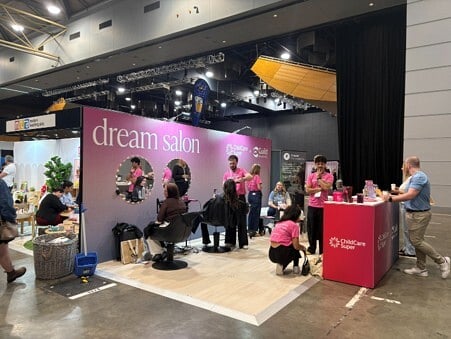
A massive 114 stall trade expo – and this booth was probably the highlight. Free hair cuts!
A highlight was the Child Care Super trade stand. In Australia, Child Care Super is a superannuation scheme for their educators. Employers contribute 12% for them as a mandatory minimum. To really stand out they gave away free haircuts.
ECC and ACA have made arrangements for ECC members to receive member-discounts on ECC and ACA conferences. From my perspective as the ECC CEO, attendance was extremely valuable and I learnt a lot and made good connections. In some cases, Australia has better solutions than what we have. In general, their state and federal governments are more supportive and enabling of the ECE sector (and for example funding a lot of professional development for educators) than what we have become used to in NZ.
The next ACA Conference is 11-13 June 2027 in the Gold Coast. We will let you know when registrations open. Find out more about the Australian Childcare Alliance (ACA) here.
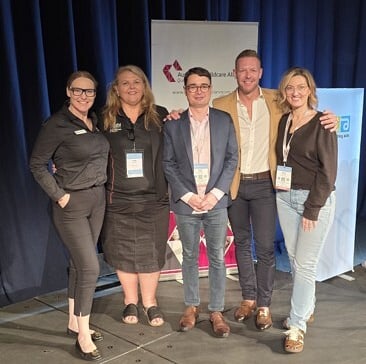
Carly Irving-Dolan (ACA Queensland), Lousie Thomas (ACA Queensland), Simon Laube (ECC), Jae Fraser (ACA Queensland), Joelene Waugh (Auckland University)
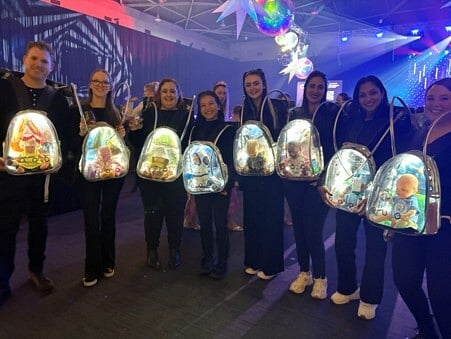
Even the men in Australia can carry babies!
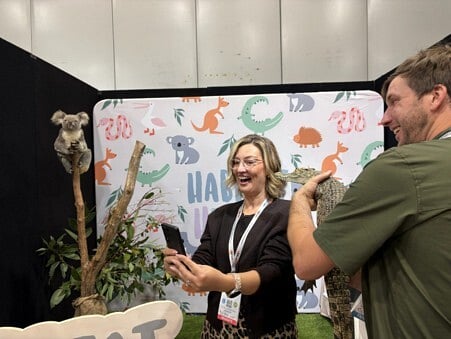
Not your usual trade expo at the ACA conference: Joelene Waugh from Auckland University meets “Snappy” the crocodile, at the Habitat Heroes trade stand, while a koala looks on disapprovingly as people’s attention had shifted away from her.
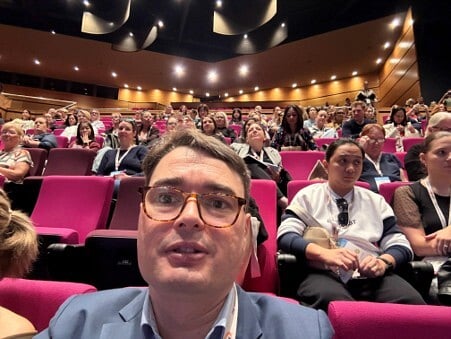
Me in a plenary session at the ACA Conference. These were huge. One brave keynote speaker began their session in complete darkness after the entire suburb lost power for about 15 minutes