If you have ever had a conversation with a child before, you would know that their imagination and creativity are unmatched. As children are still learning the rules of the world around them, they often come to conclusions that an adult mind can’t fathom. Their unique logic and limited information have often made me smile during my years working with these tiny problem solvers.
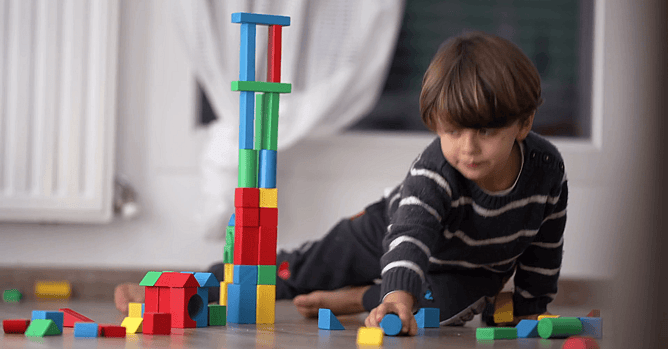
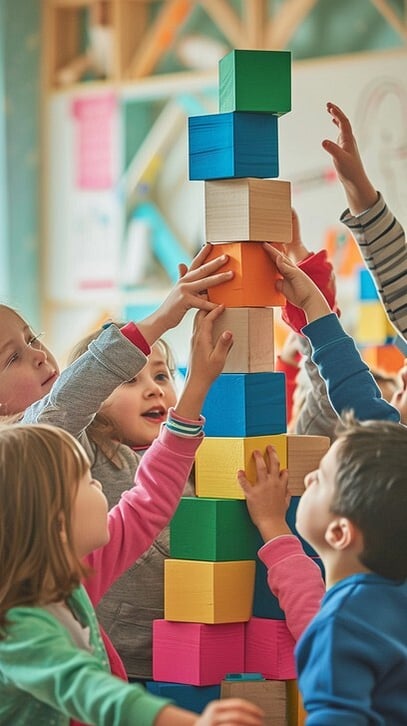
When I was working in the toddler room, I once noticed a few children playing in the block corner. One child in particular was very adamant about making a ‘tall tower’. When the tower was taller than him, and he couldn’t add any more blocks, he got a chair so he could reach the top. It was heartwarming to see his friends holding the chair so he wouldn't fall.
After observing them for a while, I asked the child what he was doing. He gave me a big smile and told me that he was making a ‘tall tower’. After a bit of back and forth, I finally asked him why he was making a tower that tall. He looked at me like it should have
been obvious, and replied, “I want a tall tower so I can reach the Sun. Sun is hot.”
This 3-year-old wanted to make a tower out of playing blocks so he could reach the Sun because he was feeling cold.
And that is one of the most toddler logic things that I have heard in my entire career.
At that time, I just laughed and suggested that he should wear a jumper as he continued his construction. However, when I later reflected on that conversation, I realised that the child was using his limited information to solve a daunting problem. And his solution was not only creative, but also logical.

For a little context, we had been discussing the Solar System in the toddler room for a few weeks, and I was the one who told these children that the Sun is a ‘big ball of fire’.
So, in this situation, when the toddler was feeling cold, he remembered what I had said, that the Sun was a big ball of fire. And added his previously gained information – that the fire is hot. Then he used logic – that if he is feeling cold, he should get warm somehow. Thus, he came to the conclusion – that if he made a tower tall enough, he could reach the Sun and feel warm.
When we break it down like this, we can understand why the child came to this conclusion and even praise him for his logical thinking and problem-solving skills, even if this was not something an adult would even think of doing.
And how do children gain information to fuel their logical thinking? By observation.
It is funny how children learn about the world and how to live in it by being little detectives. They observe what others are doing around them, and they try to repeat the same. And repeat it again. Then again. Until it makes sense to them.
This is why many grown-ups lose arguments with children. They are often using the same information they learned from the grown-ups around them, just reaching very different conclusions.
This situation reminded me that children are very new to this world. They don’t usually understand how it works and what all the rules are. This also made me think how limited our adult imagination can be. When I first saw the tower, I assumed the child was just playing. It was not until I asked some open-ended questions that I figured that the child was on a mission to resolve the heating issues down on Earth.
And the most interesting part was that he wasn’t alone. All his friends joined in his cause. They didn’t question his logic or point out that the Sun was millions of kilometres away. Instead, they wholeheartedly helped their friend who was feeling cold.
To this day, I regret that I probably missed an entire conversation between four or five three-year-olds about how the easiest way to stay warm is to build a structure to the Sun.
The more I reflected on that moment, the more I realised that children rarely approach problems the way adults do. We rely on experience, rules, and information we have collected over decades. Children don't have that luxury. They have only a small collection of facts, observations, and experiences to work with.
So, they experiment. They build theories. They test ideas.
And sometimes those ideas lead to surprisingly creative solutions.
That tower never reached the Sun. The child eventually put on a jumper and moved on to another adventure.
But the tower was never really about reaching the Sun in the first place. It was about a child trying to make sense of the world around him.
That moment made me realise that children are not simply playing. They are constantly gathering information, testing possibilities, and building their own understanding of how the world works. Sometimes that understanding is wildly inaccurate. Sometimes it is surprisingly insightful. Most of the time, it is a little bit of both.
And that is exactly why I never underestimate a ‘tall tower’.
About the Author
Rose is an Early Childhood Educator based in New Zealand, with a passion for child development and the incredible learning that takes place during the early years. Having worked with infants, toddlers, and preschool-aged children, she enjoys sharing practical insights inspired by everyday experiences in the classroom.
Through storytelling, real-life observations, and evidence-informed practice, Rose writes about play, behaviour, curiosity, creativity, and the many ways young children make sense of the world. Her goal is to help parents and educators better understand and support children's learning while celebrating the wonder of childhood.