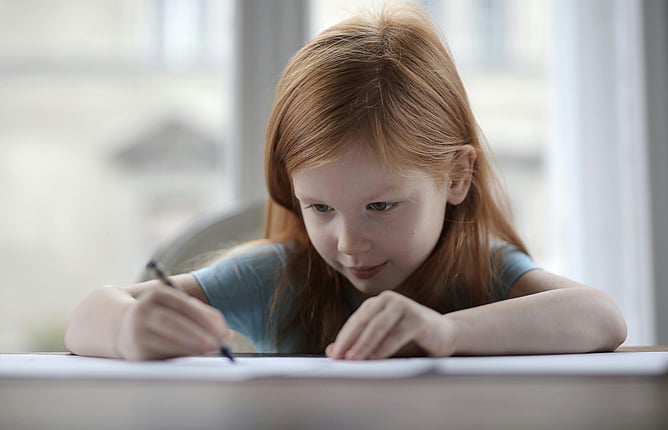
Empowering children through creative risk and authentic expression
Take a blank sheet of paper and try drawing something. For many adults, it’s unexpectedly nerve-wracking. What do you draw? Where do you start? Overthinking quickly takes over. A blank page offers the opportunity of decision making; it is possibility waiting for direction.
Visual arts give children a safe place to practice that choice. They learn to sketch ideas, organise their thoughts, test possibilities, and turn nothing into something. When we give children the opportunity to express their thoughts on a blank page, mould a block of clay, or twist and turn a straight piece of wire, this isn’t just creativity; it’s life training. It’s how children learn to think, decide, take risks, and trust their own ideas.
A child’s artistic expression is not simply a pretty picture for the fridge. Art speaks before words – it is one of the oldest forms of human expression. If you want to understand what matters to a child, how they feel, what they are thinking – look at what they draw. In contrast to the endless possibilities of a blank page, ready-made templates like colouring books, worksheets, join-the-dot activities, or highly teacher-directed art can send a limiting message about a child’s capability.
When well-intentioned adults take over, we may unintentionally rob children of the opportunities for risk-taking, confidence-building, and the discovery of their own mana and potential. But this doesn’t mean we stay completely hands off – hovering nearby and offering only “wow, that’s a great picture.” I’ve been guilty of that myself, before learning more intentional ways to support children’s artistic processes.
The role of adults in children’s visual art exploration
How can we be thoughtfully and moderately involved without taking over? Finding the balance between support and struggle is one of the greatest challenges for us as adults. What helps is gaining a sound perspective of these struggles as opportunities in disguise; a powerful teaching moment for both the child and adult guiding them.
Overcoming struggle builds strength, just as children develop capability through challenge. In early childhood, teachers witness this every day, and our choice is to step in or step back – either create dependency or empower children. We wouldn’t climb the monkey bars for a child, because every attempt strengthens their body, mind, and sense of agency. We join alongside, observe, comment, and support – but we never take over.
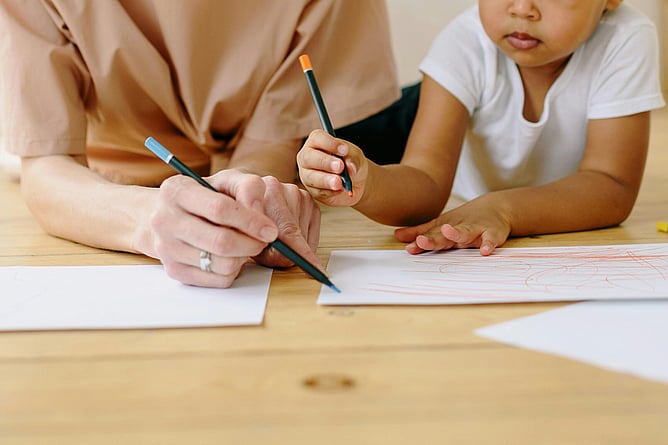
In creative learning, we don’t draw for children, we draw alongside them. The shift happens when we see a child’s artwork not as a final product, but as a process of enquiry, problem-solving and expression. When a child shows you their drawing, instead of saying “What a great picture” try saying instead, “I can see you really enjoyed making this” or “tell me more about your picture.” This opens up conversation about colours, shapes, brush strokes and ideas – sending children a powerful message that the delight of the creative process matters just as much, if not more, than the final result.
Useful, practical ways to draw alongside a child might include drawing with our less dominant hand or intentionally leaving drawings imperfect, exploratory, and unfinished. These small shifts signal that we are co-learners, not experts. At times, it may be as simple as making a small mark to help a child begin or slowing down to break down what we see together.
Visual art exploration through chick sketches
A standout moment of 2025 was our tamariki welcoming living eggs into our learning environment. The children were instantly curious – asking questions, observing and expressing their thoughts through art. There were spontaneous drawings of eggs in every corner of the room, telling us through the language of drawing “I’m interested in this; this matters to me.”
Yet, the moment the chicks began to hatch, all the egg drawings disappeared, and children returned to drawing what seemed more within their comfort zone. When invited to draw the half-hatched chicks, most children responded with “I can’t draw that.” This highlighted a disconnect between their interest and their confidence; it was moment of struggle, one of those rich learning opportunities we recognise as educators. It dawned on us that we needed a warmup before engaging in unfamiliar or challenging tasks.
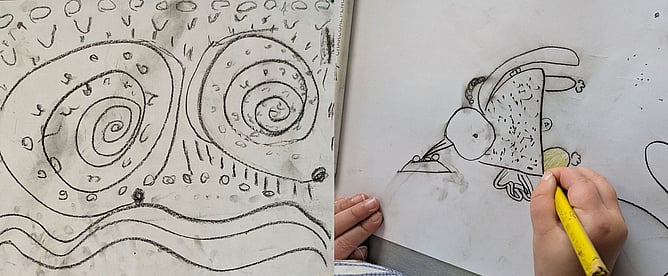
We started by introducing a rich array of line drawings or what I call deliberate mark making. Drawing begins with a grammar of lines – simple, deliberate marks that help children make sense of form, movement, and their own ideas. Repeatedly exploring line drawing built competence and confidence in our children, and we supported them to take risks by offering whiteboards or blackboards so marks could easily be erased.
One day, a tamaiti proudly announced “Look! I connected my lines to make this!” This demonstrates how skills develop when children are offered time, materials, and gentle scaffolding without adults taking over.
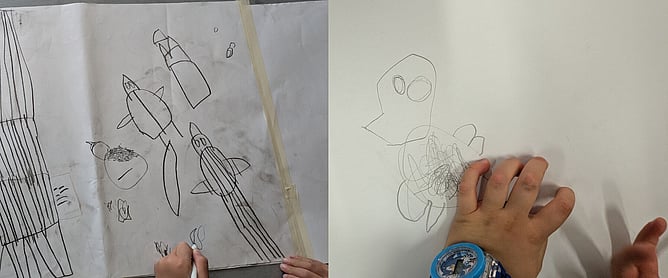
By now most of our chicks had hatched, and it was time to revisit our challenge of observational drawing. We decided to capture the chicks through drawings to remember them before they grew up and left. Black pencils and paper were offered, intentionally keeping colours aside to encourage focus and minimize temptation to draw the familiar rainbows and such. Predictably, the children started with hesitant ovals and requests like “can you draw it for me?” But we didn’t. Instead, we scaffolded through narration, modelling alongside, and breaking forms into simple lines and shapes.
As the struggle intensified, one of our younger learners kept saying “I can’t draw, you have to draw for me.” She was reluctant to put pen to paper and take the risk of starting. By repeatedly breaking the form into simple lines and beginning with just the eyes, she was able complete her drawing, wiping away tears as she proudly said, “I did it.” Another child exclaimed “I don’t know how to draw a chick” before pausing and adding “but I do know how to draw a beak.” And with that, she was away. It was the familiar zigzag line of the beak we had been practicing that gave her a place to start; a small, known step unlocked something bigger, not just for her but for the rest of the group.
As the children slowed down, really looked, and trusted themselves enough to begin, we watched their confidence grow. The resulting drawings were diverse, expressive and deeply individual. A powerful reminder that when we step back from being the expert, children step forward as creators. By noticing what each child could already do and offering a gentle stretch just beyond their comfort zone, we supported real, meaningful progress.
Recognising the educational value of visual arts in our centre, we appointed a dedicated artist to work with our 3 to 5 year old tamariki once a week. This initiative has had a profoundly positive impact, nurturing the children’s curiosity and enthusiasm for exploring and expressing themselves through a range of visual media. With additional support from our curriculum leader Jo Clark, our goal is to further deepen our enquiry through the visual arts.

Guneet Sachdev is an early childhood educator, leader and researcher with over a decade of experience in Aotearoa New Zealand. She believes that when children feel truly seen and heard, their natural curiosity becomes a powerful driver for learning. Grounded in positive guidance and deep respect for each child’s unique identity, her practice champions children’s agency, positioning them as co-learners, play partners and active meaning-makers.
In her role as educational leader and centre supervisor at Nurture Early Learning, Guneet mentors teachers and facilitates workshops for parents and educators. Drawing on a creative background in theatre and storytelling, her work focuses on practical, heart-centred strategies that nurture children’s social, emotional, and cognitive development.