Often in early learning settings dance comes as an add-on to music, as suggested by the phrase ‘Music and Movement’, but there is more to dance than this. This article considers the benefits of dance, the teacher’s role and links to Te Whāriki with the aim to widen teachers’ perceptions of dance and its place in early childhood education.
Benefits of Dance
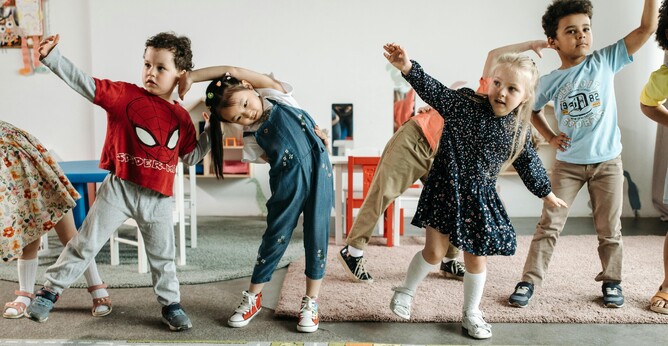
Dance has many benefits, the most basic being linked to children’s ability to control and have an awareness of their bodies. It is important that children explore dance without fear, which can limit their explorations. Dance is not only moving rhythmically; it is being aware of movements and pauses. These rhythmic patterns are present in the infant-caregiver relationship underpinning creative thinking; they are part of motor and brain development and can benefit cognitive function. Children need to experience movement as they explore the connection between mind and body.
Children naturally use their bodies to explore the four basic principles of dance: movement, space, time and energy. Movement can include interacting with others, so they may need to follow instructions, listen for cues and respect what others are doing. Through dance, space contrasts of high-low, right-left, backwards-forwards and diagonals can be explored, creating spatial intelligence. The concept of time is fostered through fast-slow and the action of freezing, and energy is explored by moving through imagined scenarios such as stomping through puddles or moving on hot surfaces. Pull-push, repetition, sequences and answering each other with opposite moves can also be implemented to enhance children’s learning through dance.
Dancing and movement can also evoke a range of feelings for young children, from using dance to express emotions, imagination and thoughts, to exploring joy and creativity. Dance helps with emotional regulation, social skills and self-control. It encourages positive emotions and reduces cortisol levels, which lowers stress. There is even some evidence that suggests dance can improve the social skills of children with Autism Spectrum Disorder (Chatzihidiroglou et al., 2018). Dance extends children’s ability to communicate because it allows them to express what they may not be able to communicate orally or in writing/pictures.
The Teacher’s Role
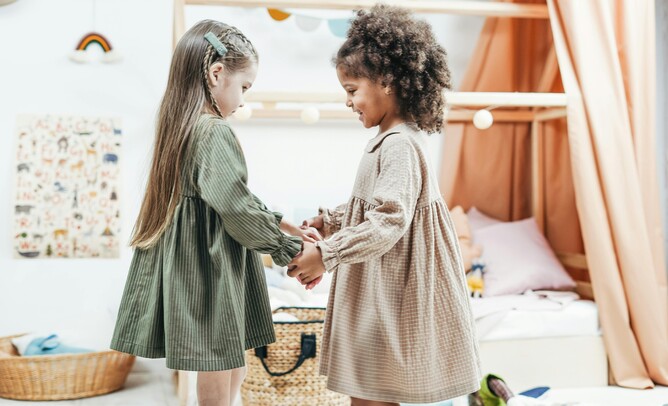
Further to the benefits discussed above, there are other ways teachers can use dance to encourage learning too. Teachers should try to respond without commenting but instead use their body to do so. This helps children to identify, validate and encourage new thinking. The teacher needs to be comfortable with being influenced by others without definite beginnings and endings; this leads to a shift in power from the teacher to the children and creates a negotiation of the rules.
Exposure to different kinds and styles of music can be also useful so that children can physically experience the music. “When children put music in their bodies, they learn the music, the music comes alive in them and they become the music” (Bennett, 2012, as cited in Lindeman, 2019, p. 10). Opportunities to make up or improvise movements to many styles of music is important, and singing can also be incorporated. Teachers can provide props and costumes, keeping things age appropriate and focussed on the process rather than the product.
Links to Te Whāriki
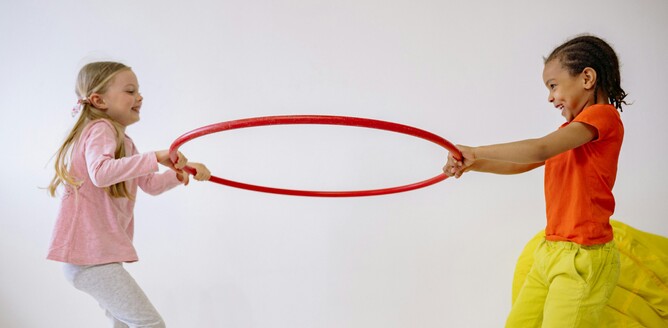
Te Whāriki supports children’s exploration with their bodies in a variety of ways. Dance can be a means of empowerment by providing an environment that ensures they are able to create and act on their own ideas. The Exploration strand emphasises children being confident in and in control over their bodies by “moving confidently and challenging themselves physically” through activities that include “locomotion, movement skills, agility and balance” (MoE, 2017, p. 47). Dance helps to develop balance as most movement requires some degree of balance, and children’s communication and creativity are supported through using movement to express themselves.
Te Whāriki provides numerous examples of practices that align with using dance as an educational tool. This includes opportunities for movement and participation in dance, access to props that stimulate imaginative play, and creativity by being able to use their whole bodies in dance and gesture. Through considering the benefits of dance, teachers develop a broader understanding of the medium and how to successfully incorporate dance into the curriculum. By using Te Whāriki as a framework for having a more holistic view of dance, teachers can provide dance experiences that are more child centred and inclusive.
Maddie Hendrie has been a lecturer at New Zealand Tertiary College since 2019. She has a background in Playcentre, home based care and early childhood centres having worked in Assistant Manager, Operational Manager and Head Teacher roles. Maddie also has considerable experience working with adults, including being an Associate Teacher, leading workshops and mentoring learners for teacher registration. Her lifelong passion for dance is reflected in dancing at church and around home with her adult daughters and two granddaughters.
References
Barton, G. (2015). Arts-based educational research in the early years. International Research in Early Childhood Education, 6(1), 62-78.
Brown, E.D., Garnett, L.M., Anderson, K.E., & Laurenceau, J-P. (2017). Can the arts get under the skin? Arts and cortisol for economically disadvantaged children. Child Development, 88(4), 1368-1381.
Chatzihidiroglou, P., Chatzopoulos, D., Lykesas, G., & Doganis, G. (2018). Dancing effects on preschoolers’ sensorimotor synchronization, balance and movement reaction time. Perceptual and Motor Skills, 125(3), 463-477.
Faber, R. (2017). Dance and early childhood cognition: The Isadora effect. Arts Education Policy Review, 118(2), 172-182.
Lindeman, C.A. (2019). Musical children: Engaging children in musical experiences (2nd Ed.). Routledge.
Massing, C., Pente, C., & Kirova, A. (2016). Immigrant parent-child interactional dance duets during shared art-making experiences. European Early Childhood Education Research Journal, 24(1), 37-50.
Ministry of Education. (2017). Te Whāriki: He whāriki mātauranga mō ngā mokopuna o Aotearoa: Early childhood curriculum. education.govt.nz.
Nelson, C., Paul, K., Johnston, S.S., Kidder, J.E. (2017). Use of a Creative Dance Intervention Package to Increase Social Engagement and Play Complexity of Young Children with Autism Spectrum Disorder. Education and Training in Autism and Developmental Disabilities, 52(2), 170-185.
Pape-Pedersen, I. (2022). Teacher body(ing) kindergarten space(s) -an arts-based pedagogical development project for kindergarten teachers. European Early Childhood Education Research Journal, 30(5), 715-729.
Samuelsson, I.P., Carlsson, M.A., Olsson, B., Pramling, N., & Wallerstedt, C. (2009). The art of teaching children the arts: music, dance and poetry with children aged 2-8 years. International Journal of Early Years Education, 17(2), 119-135.
Samson, A. (2015). Reciprocal engagement in dance: Empowering encounters in New Zealand early childhood settings. In C.S. Nielsen & S. Burridge (Eds.), Dance around the world: Perspectives on dance, young people and change.(pp. 34-49). Routledge.
Thompson, J., & Pearce, N. (2022). A Toolbox for Engaging Children in Play and Creativity for Learning Across the Domains. Dimensions, 50 (1), 37-43.
Walter, O., & Sat, E. (2013). Dance and its influence on emotional self-control and regulation and emotional intelligence abilities among early childhood-aged children. International Journal of Arts and Sciences, 6(4), 77-97.
Whyte, M., & Naughton, C. (2014). “What’s our next move? Seeing children in the light of potentialities. He Kupu, 3(4), 3-18.
Yetti, E., Syarahb, E.S., Saric, K.M., Oktarinid, S., Nurdyanae, T., Syakhrunif., Puspawatig, G.A.M. & Jovankah, D.R. (2023). Children’s Multicultural Education through Local-Dance Activities: Teacher's Thoughts and Involvement. International Electronic Journal of Elementary Education, 16(2), 183-192.
Yim, H.Y.B., Boo, Y.L., & Ebbeck, M. (2014). A study of children’s musical preference: A data mining approach. Australian Journal of Teacher Education, 39(2), 21-34.